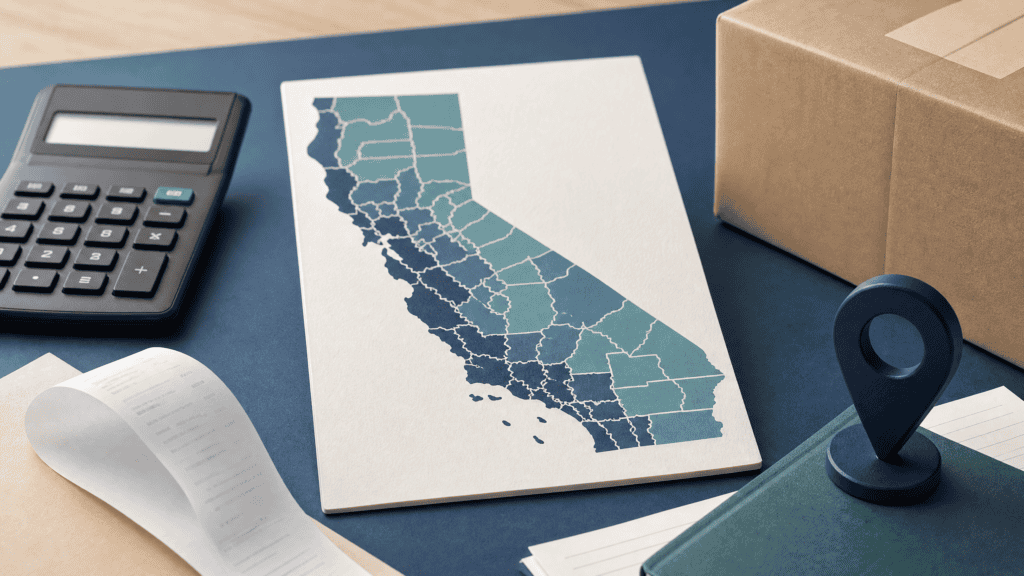
California sales tax starts with a 7.25 percent statewide base rate, but the amount charged at a particular location can be higher because local and district taxes may apply. The California Department of Tax and Fee Administration says the specific sales and use tax rate has three parts: the state rate, the local rate and any district rate in effect.[1] [2]
This is why a shopper in Los Angeles, San Diego or San Jose should not assume that one statewide number is the final rate. A city or county can fall within one or more district tax areas, and the rate can change when a new district tax becomes effective. A street address is often more useful than a ZIP code alone.
This article explains California’s base rate, local and district taxes, the official address lookup and simple calculation examples. It is general information rather than a tax determination for a specific person or business. For a real invoice, use the current CDTFA rate source and review the item’s taxability.
Table of Contents
ToggleCalifornia Sales Tax at a Glance
| Item | California information |
|---|---|
| Statewide base sales and use tax rate | 7.25 percent |
| Local and district additions | Vary by jurisdiction and effective date |
| District taxes | Can be more than one in a location |
| Exact rate lookup | CDTFA address lookup and current city/county table |
| Rate source reviewed for this brief | CDTFA rates effective July 1, 2026 |
| Important caveat | Some unincorporated areas are not listed as incorporated cities |
The 7.25 percent rate is the statewide base. It is not a universal combined rate. CDTFA’s current city and county information shows rates that differ widely by location, and it says that some communities within a county or city may not be listed separately.[4]
CDTFA’s consumer guidance says the rate varies depending on where an item is bought or where it will be used. It also says the sales and use tax in effect at the time of purchase applies.[3]
How California Sales Tax Is Built
State rate
The statewide base is 7.25 percent. It provides the starting point for a simple tax calculation, but the final customer charge can include more layers.
Local rate
Local tax is part of the overall rate structure and can vary by jurisdiction. The relevant county or city boundaries do not always line up neatly with a mailing address or ZIP code.
District rate
District taxes are voter- or local-government-approved taxes that apply within defined areas. CDTFA says more than three-fourths of businesses in California are located or do business in areas with a district tax, and a location can have more than one district tax in effect.[3]
Use tax
Use tax generally applies when taxable goods are stored, used or consumed in California in a transaction that was not subject to sales tax. CDTFA says use tax may also apply to goods shipped to a California consumer from another state, including mail, telephone and Internet purchases.[2]
The rate parts should not be confused with the taxability question. First determine whether the item or service is taxable. Then identify the correct rate and location.
How to Find the Rate for an Address
Use CDTFA’s official address lookup for a current location-specific rate. The department also provides a city and county rate page and downloadable rate files.[1] [3]
Follow these steps:
- Identify the full delivery, retail or use address.
- Open CDTFA’s Find a Sales and Use Tax Rate tool.
- Enter the street address and review the location returned.
- Check the statewide, local and district components.
- Confirm the effective date or current rate period.
- Save the lookup result with the invoice or business record.
A ZIP code alone may not show every boundary detail. CDTFA says it is not always possible to determine the correct rate solely from a mailing address or ZIP code, and it provides address and local database resources to help retailers identify the correct rate.[3]
Unincorporated communities require extra care. CDTFA’s city and county table states that some unincorporated cities and communities are not listed, and the county or unincorporated-area rate may apply.[4]
If a business charges tax to customers, keep a rate log with the address, rate, effective date, source link and date checked. Update it when CDTFA publishes a new rate period.
Why City and County Rates Differ
California’s local tax structure is based on jurisdictions and districts, not on one uniform rate for every place with the same state name. A purchase in an incorporated city can have a different combined rate from a purchase in an unincorporated county area.
The same county can contain cities with different district taxes. A customer in Los Angeles County should not automatically use one Los Angeles County figure for every city in the county. The city, district boundaries, delivery details and current effective date may change the result.
District taxes can also change over time. CDTFA’s current rate page lists rates effective July 1, 2026 and provides historical and active district-rate resources.[1] [4] If a seller continues using an old table, it may collect too little or too much tax.
CDTFA’s consumer guidance explains that a customer who buys an item from outside California for use in the city or county where the customer lives may owe use tax if tax was not collected.[3] That is another reason the location where an item will be used can matter.
How to Calculate California Sales Tax
For a simple taxable purchase, use:
Sales tax = taxable price x combined tax rate
Convert the percentage to a decimal before multiplying. A combined rate of 9.5 percent becomes 0.095.
For a taxable $200 item at a 9.5 percent combined rate:
$200 x 0.095 = $19 tax
The total paid would be:
$200 + $19 = $219
This example assumes the item is fully taxable, the 9.5 percent rate applies to the location and transaction, and no special rule changes the tax base.
If the tax is already included in the total and the correct rate is known, divide the tax-inclusive total by 1 plus the rate as a decimal. At 9.5 percent:
$219 / 1.095 = $200 pre-tax amount
A reverse calculation can separate a known tax-inclusive total. It cannot decide which California district applies or whether the item is taxable.
A rate comparison example
A $500 taxable purchase at a 7.25 percent rate produces $36.25 in tax. The same purchase at a 9.75 percent rate produces $48.75 in tax. The difference is $12.50 on the same pre-tax price.
The example is not a rate claim about a particular city. It shows why the final rate should be checked for the actual address instead of assumed from the statewide base.
California Use Tax and Online Purchases
California use tax generally concerns taxable goods purchased in a transaction where sales tax was not charged and then stored, used or consumed in California. CDTFA says the rule can include purchases shipped from another state and delivered to a California consumer.[2]
For an online purchase, keep the order confirmation, delivery address, item description, tax line and seller information. Check whether the seller or marketplace collected California tax. If tax was not collected, review the current CDTFA guidance for the buyer’s situation.
A resale purchase can create another question if the buyer later uses the item rather than reselling it. A seller’s permit, resale documentation and business records should match the actual use of the purchase.
Businesses operating in California must register with CDTFA and pay the state’s sales tax on taxable retail sales, subject to the rules and exemptions that apply. CDTFA provides seller-permit, filing, use-tax and tax-rate resources.[2]
Do not use a broad calculator result as proof of compliance. A calculator can multiply a taxable amount by a rate. It does not resolve nexus, taxability, resale status, district boundaries or filing obligations.
Common Questions About California Sales Tax
What is the California sales tax rate?
The statewide base sales and use tax rate is 7.25 percent according to CDTFA.[1] [3]
Is California sales tax always 7.25 percent?
No. Local and district taxes can increase the combined rate, and a location may have more than one district tax.
How do I find California sales tax by address?
Use CDTFA’s official address lookup and review the current city and county rate information. A full address is safer than relying only on a ZIP code.[3]
Why is the rate different in Los Angeles, San Diego and San Jose?
Cities and counties can fall within different local and district tax areas. The exact rate depends on the address and effective period, so check CDTFA’s current lookup.
Does California have use tax?
Yes. Use tax can apply to taxable goods stored, used or consumed in California when sales tax was not paid, including some out-of-state or online purchases.[2]
What rate applies in an unincorporated California area?
The county or unincorporated-area rate may apply. CDTFA says some unincorporated communities are not listed in the city table, so use the location resources rather than guessing from the nearest city.[4]
What happens if a rate changes after I bought an item?
CDTFA says the sales and use tax in effect at the time of purchase applies.[3] Keep the invoice date and the rate source with the transaction record.
Can I separate tax from a California receipt total?
Yes, if the correct combined rate is known and the total includes only the tax being separated. Divide the total by 1 plus the rate as a decimal. Confirm the location and taxability first.
California sales tax is easiest to calculate when the item, address, district and effective date are all correct. Start with the 7.25 percent statewide base, check the local and district additions, and keep the official source with the calculation.
Internal links for publishing
| Suggested anchor | Destination |
|---|---|
| California sales tax calculator | https://reversesalestax.com/states/california-sales-tax-calculator/ |
| reverse sales tax calculator | https://reversesalestax.com/ |
| what is use tax | https://reversesalestax.com/what-is-use-tax/ |
| state sales tax rates | https://reversesalestax.com/sales-tax-rates/ |
Use the California calculator link only when the location-specific tool exists. Until then, link to a functioning general calculator with a truthful anchor.
Writer and publisher QA
| Check | Status |
|---|---|
| One H1 only | Pass in article structure |
| H2 count below 10 | Pass: 7 article H2 headings |
| H3 to H6 hierarchy | H3 used for rate parts, comparison example and FAQs |
| Focus keyword ownership | Pass: California guide owns the state and local informational intent |
| Rate freshness | Verify the current CDTFA rate table immediately before publishing |
| Address caveat | Included with CDTFA support |
| Unincorporated-area caveat | Included with current table support |
| Forbidden words and symbols | Run against the saved anti-AI rules file |
| Feature image | Generate and inspect before upload |
| Similarity review | Run against competitor/source pages and current site posts |
| Responsive review | Test after WordPress publication |
Sources
Source links used for this article are listed below. Rules and rates can change, so check the relevant official guidance for current details.
- California Department of Tax and Fee Administration, California City and County Sales and Use Tax Rate Information.
- California Department of Tax and Fee Administration, Sales and Use Tax in California.
- California Department of Tax and Fee Administration, Know Your Sales and Use Tax Rate.
- California Department of Tax and Fee Administration, California City and County Sales and Use Tax Rates.