
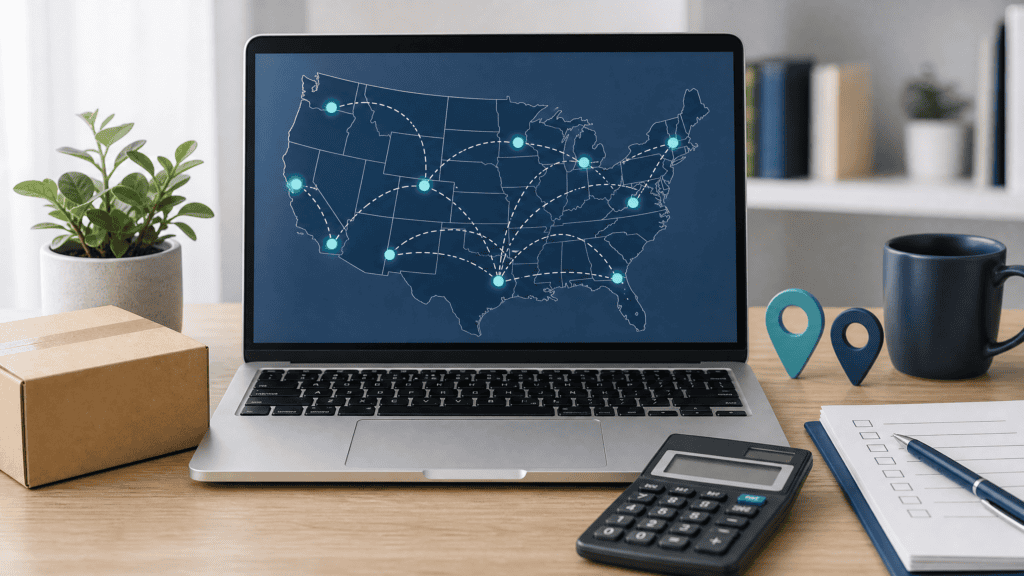
Online sales tax economic nexus is a state-law connection that can require an out-of-state business to register, collect and remit sales tax after its sales into that state reach a defined level. A seller may have no store, warehouse or employee in the state and still need to review a collection duty.
Economic nexus is only one part of the analysis. Physical presence, marketplace activity, product taxability, customer location, registration rules and filing dates can also matter. The threshold and collection rule are not the same in every state.
Indiana, Iowa and North Carolina show how the details differ. Indiana describes a $100,000 gross-revenue threshold for remote sellers. Iowa includes marketplace and non-marketplace revenue in its threshold guidance. North Carolina uses a $100,000 gross-sales threshold and has a specific start-date rule for a seller whose only basis is the threshold.[2] [3] [4]
This article explains the framework and a practical review process. It is general education, not a registration decision for a particular business. A seller should use current state guidance or professional advice when a threshold, exemption, marketplace agreement or filing obligation is at issue.
Table of Contents
ToggleWhat Economic Nexus Means for Online Sellers
Economic nexus focuses on the amount or value of a business’s sales into a state rather than only its physical footprint. A state can set a sales or transaction threshold. When a seller crosses the applicable threshold, the state may require registration and collection for taxable sales.
The threshold can be measured using gross revenue, retail sales, taxable sales, transactions or another state-defined measure. Some states count marketplace sales. Other rules can exclude or treat certain sales differently. Never copy one state’s threshold definition into a nationwide spreadsheet without checking the source.
Economic nexus does not automatically mean every sale is taxable. The seller still needs to identify the product, service, exemption, sourcing rule and tax rate. It also does not automatically mean the seller must collect in every state once it crosses one state’s threshold.
Indiana example
Indiana says a remote seller must collect and remit applicable sales taxes when gross revenue from sales into Indiana exceeds $100,000 in the previous or current calendar year.[2] The page includes tangible personal property, digital products and services delivered into Indiana. Indiana states that, effective January 1, 2024, it uses only the $100,000 threshold rather than the earlier alternative transaction threshold.[2]
Iowa example
Iowa says a remote seller must collect Iowa sales tax and local option sales tax when gross revenue from Iowa sales reaches $100,000. Its guidance includes marketplace and non-marketplace sales in the review, and it defines Iowa sales broadly for threshold purposes.[3]
North Carolina example
North Carolina says a remote seller must register and collect when gross sales sourced to North Carolina exceed $100,000 in the previous or current calendar year. It counts marketplace-seller and marketplace-processed sales in its threshold statement.[4]
These examples are useful because they demonstrate a shared pattern without proving a universal rule.
Physical Nexus, Economic Nexus and Marketplace Facilitators
Physical nexus
Physical nexus can arise from a store, office, warehouse, inventory, employee, representative, installation activity, trade-show presence or another state-defined connection. The exact definition differs, so a seller should check the state’s own guidance.
Physical presence can create a collection duty even when sales are below an economic threshold. North Carolina, for example, says sellers with a physical presence or another legal requirement must collect whether or not they exceed its stated threshold.[4]
Economic nexus
Economic nexus is tied to sales activity into the state. The seller does not need to open a local facility for the threshold to matter. Record gross sales and transaction dates by state so the business can spot a threshold before the next filing period.
Marketplace facilitator
The cited marketplace guidance describes a marketplace facilitator as a business that owns, operates or controls a physical or electronic marketplace and facilitates third-party sales, generally by providing infrastructure or support and collecting payment or compensation.[1]
A marketplace may be required to collect and remit tax on marketplace sales. But the marketplace seller may still have registration, filing, notice, exemption or recordkeeping duties. The cited guidance says states may define the term more narrowly or broadly and that state law controls.[1]
A seller should not assume that “the marketplace collects tax” ends the seller’s compliance review.
How State Thresholds Are Measured
Read each state’s threshold definition instead of relying only on a dollar figure.
Gross revenue versus taxable sales
Some states measure gross revenue from sales into the state, which can include exempt, wholesale or marketplace sales. Iowa expressly says its threshold is based on gross revenue and includes sales categories that may not be taxable at checkout.[3]
Other states may describe the threshold using retail sales, taxable sales or another defined term. The spreadsheet should copy the state’s wording and source.
Previous year and current year
A state may test the previous calendar year, current calendar year, previous or current year, prior twelve months or current quarter. The measurement window affects when a seller crosses the threshold.
Transactions
Some state pages still describe transaction thresholds, while others have removed them or changed how they work. Indiana states that it uses only its $100,000 threshold effective January 1, 2024.[2] Do not leave an old 200-transaction rule in a current content table without confirming it.
Marketplace sales
A state can count marketplace sales when measuring a seller’s or facilitator’s threshold. Iowa says marketplace and non-marketplace sales can be included in the remote seller’s threshold review.[3]
Effective date
The date a seller crosses a threshold may not be the same date collection begins. North Carolina gives a start-date rule for a retailer whose sole basis is crossing its threshold, effective July 2, 2026.[4] Other states can use different timing.
What to Do After Reaching a Threshold
Use a controlled sequence:
- Confirm the state’s current threshold and measurement period.
- Confirm whether the business has physical presence or another collection duty.
- Separate direct website sales from marketplace sales.
- Review the marketplace’s collection and reporting documents.
- Determine taxable products, services and exemptions.
- Identify the registration route and collection start date.
- Set the correct tax rate and sourcing method.
- File returns, even if the current period has little or no tax due when the state requires a return.
- Keep the source, calculation and registration record.
Registration is not the only step. A seller may need a permit, tax account, filing calendar, exemption process, invoice language, refund process and record retention policy.
Do not turn a calculator into a compliance conclusion. A sales tax calculator can estimate tax from a rate and taxable amount. It cannot tell a seller whether economic nexus exists or which state rule controls.
Marketplace Sales and Direct Website Sales
A business can sell through a marketplace and its own website. Treat the channels separately in the records, then follow the state’s threshold definition.
Iowa gives a useful example: a remote seller with marketplace and non-marketplace sales adds the gross revenue from both types when determining whether it must collect. If the facilitator collected tax on part of the sales, the seller may still need to report the sales and take the permitted deduction under Iowa’s rules.[3]
The result is not the same in every state. Keep a channel report with:
| Record | Why it matters |
|---|---|
| State destination | Threshold and sourcing review |
| Order date | Measurement period and rate date |
| Gross sales | Threshold calculation |
| Taxable sales | Collection and return calculation |
| Marketplace sales | Facilitator and seller reconciliation |
| Tax collected | Avoiding under- or over-collection |
| Refunds and returns | Correcting the sales record |
| Exemptions | Support for non-taxed sales |
Ask the marketplace for documentation that identifies the tax collected and remitted. A seller should also know which sales remain its direct responsibility.
How to Build a State-by-State Review Process
Create a state matrix with one row per state and these columns:
| Column | Example entry |
|---|---|
| State | Indiana |
| Threshold wording | Gross revenue from sales into state |
| Amount | $100,000 |
| Measurement period | Previous or current calendar year |
| Marketplace sales counted | Confirm from current source |
| Physical nexus trigger | Review state guidance |
| Registration page | Official state URL |
| Collection start rule | Effective-date wording |
| Rate and sourcing source | Official rate lookup |
| Last reviewed | Date and reviewer initials |
Assign one owner to monitor official notices. A dated source is more useful than an undated spreadsheet. Threshold pages can change after legislation, court decisions, department notices or administrative updates.
Use state sources for the final decision. The cited marketplace guidance offers a useful general explanation, but its page says that individual state laws control.[1]
For a small business, a monthly review can be enough to identify a fast-growing state before the next filing cycle. For a larger seller, use software-based destination reporting and a documented tax engine or advisor review.
Common Questions About Online Sales Tax Nexus
Can an online seller have economic nexus without a physical store?
Yes. Economic nexus is based on state-defined sales activity, so a physical store is not always required.
Is economic nexus the same as physical nexus?
No. Physical nexus concerns a physical or other connection defined by state law. Economic nexus focuses on sales activity or another economic threshold.
Does a marketplace always collect the seller’s sales tax?
No universal answer exists. Many states require marketplace facilitators to collect, but definitions, thresholds and seller duties vary. Check the state source and marketplace documentation.[1]
Do marketplace sales count toward a threshold?
They can. Iowa expressly includes marketplace and non-marketplace revenue in its threshold guidance.[3] Other states must be checked individually.
Is $100,000 the threshold in every state?
No. $100,000 is common in many state examples, but the amount, measurement period, included sales and collection start date can differ.
When does a seller start collecting after crossing a threshold?
It depends on the state. North Carolina’s current guidance gives a specific start-date rule for a seller whose only basis is crossing its threshold.[4]
What records should an online seller keep?
Keep destination, order date, gross sales, taxable sales, marketplace reports, tax collected, returns, exemptions, rate sources and registration records.
Can a calculator tell me whether I have nexus?
No. A calculator can perform the arithmetic after the correct rate and taxable base are known. Nexus requires a state-law review of the business connection and sales activity.
Online sales tax economic nexus is best managed as an ongoing review rather than a one-time decision. Track state activity, identify physical and marketplace connections, read the current threshold definition and record the date that each rule was checked.
Internal links for publishing
| Suggested anchor | Destination |
|---|---|
| state sales tax rates | https://reversesalestax.com/sales-tax-rates/ |
| what is use tax | https://reversesalestax.com/what-is-use-tax/ |
| California sales tax | https://reversesalestax.com/states/california-sales-tax/ |
| Ohio sales tax | https://reversesalestax.com/states/ohio-sales-tax/ |
| reverse sales tax calculator | https://reversesalestax.com/ |
Writer and publisher QA
| Check | Status |
|---|---|
| One H1 only | Pass in article structure |
| H2 count below 10 | Pass: 7 article H2 headings |
| H3 to H6 hierarchy | H3 used for definitions, examples and FAQ |
| Threshold dates | Must recheck immediately before publication |
| State-specific claims | Each example linked to official or multistate source |
| Legal/compliance tone | General education only; no personal conclusion |
| Forbidden words and symbols | Run against the saved anti-AI rules file |
| Feature image | Generate and inspect before upload |
| Similarity review | Run against source pages and current site posts |
| Responsive review | Test after WordPress publication |
Sources
Source links used for this article are listed below. Rules and rates can change, so check the relevant official guidance for current details.