

Marketplace facilitator sales tax starts with a simple idea: a marketplace facilitator is a marketplace that sells goods for third party sellers and, in most states with sales tax, must collect and send sales tax on those marketplace sales itself. That rule changed how many small sellers handle tax. If you sell only through a qualifying marketplace, the marketplace may collect the tax for you on those sales. If you also sell direct from your own shop or site, you still owe tax on the direct sales yourself, when the normal rules apply.
This post focuses on marketplace facilitator sales tax, the rule in general, and on Etsy, Shopify, and Walmart as examples of how the rule works in practice. It does not repeat the Amazon and eBay detail from the site post on those two marketplaces. For Amazon and eBay, read Amazon and eBay Sales Tax. Use this post for the rule itself, and for the other marketplaces named here.
Marketplace facilitator sales tax: what a facilitator does
A facilitator is not just a site that lists goods. It is a marketplace that helps make the sale, such as by taking payment, setting terms, or handling the order. When a state has a facilitator law, a qualifying facilitator must register, collect tax on sales made through its marketplace into that state, and send that tax to the state.
The seller still owns the goods and still makes the sale in a business sense, but the tax collection duty for that marketplace sale sits with the facilitator. The buyer pays tax at checkout on the marketplace, and the facilitator sends it to the state. The seller does not collect that tax a second time on the same sale.
That rule applies only to sales made through the facilitator. It does not cover sales made on the seller’s own site, in a shop, or through a different channel. Those direct sales are the seller’s own responsibility.
Etsy, Shopify, and Walmart: how they differ
Etsy is a marketplace where buyers and sellers meet on Etsy’s site, and Etsy handles the order and payment for marketplace sales. In states with a facilitator law, Etsy collects tax on those sales. A seller who sells only on Etsy will usually see tax collected by Etsy on the order, and will not need to collect it again on that order. The seller still needs to keep Etsy reports, because the seller’s own records must show which sales were marketplace sales.
Shopify is different. Shopify is mainly a tool that lets a seller run their own online shop. If a buyer buys from a seller’s own Shopify shop, that is usually a direct sale, not a facilitator sale, and the seller must collect tax when the normal rules apply.
Shopify has tools that help a seller set tax rates, but the duty to collect on a direct sale stays with the seller. Shopify also has a marketplace feature in some cases, where the facilitator rule can apply to sales made through that marketplace part. Do not assume every Shopify sale is a facilitator sale. Check whether the sale was made through your own shop or through a marketplace part of Shopify, and keep the two apart.
Walmart Marketplace is a marketplace where third party sellers list goods on Walmart’s site, and Walmart handles the order for those sales. In states with a facilitator law, Walmart collects tax on those marketplace sales. A seller who also sells direct from their own site must still handle tax on the direct sales apart from Walmart sales.
The key point for all three is the same: ask, for each sale, was this sale made through a facilitator marketplace, or was it a direct sale? The answer decides who collects tax on that sale.
A worked example with checked math
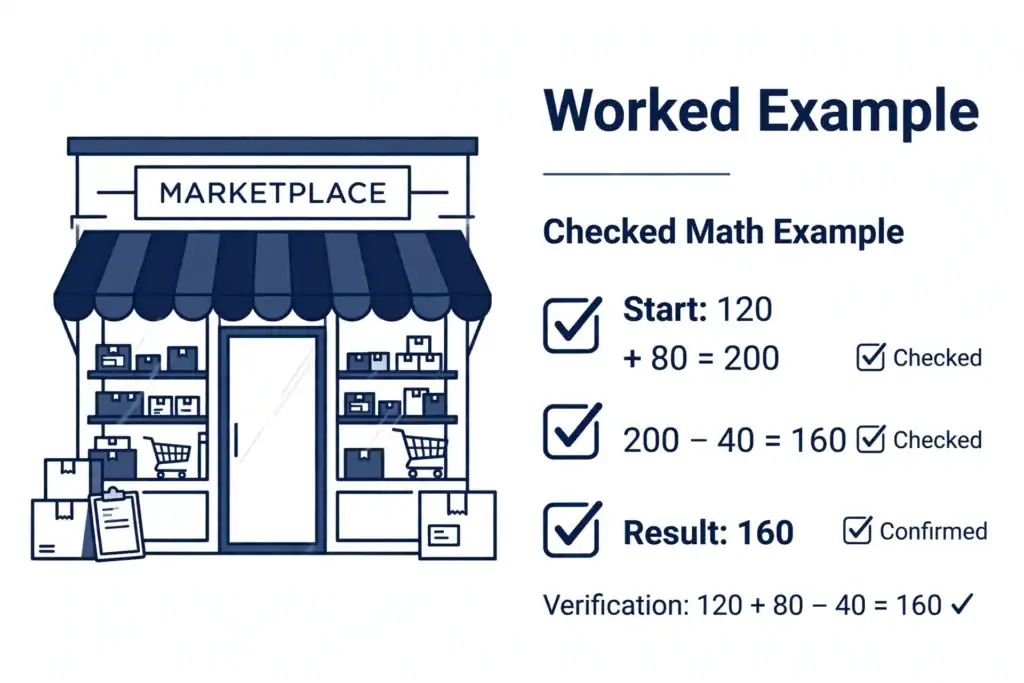
Suppose a seller makes two sales in the same period, both to buyers in the same state, at an example rate of 8 percent. This rate is an example only.
Sale one is through a qualifying marketplace. The item price is 100 dollars. The marketplace collects tax of 100 dollars times 0.08, which is 8 dollars. The buyer pays 108 dollars. The marketplace sends the 8 dollars to the state. The seller does not collect that 8 dollars again.
Sale two is a direct sale from the seller’s own site. The item price is also 100 dollars. The seller must collect tax of 100 dollars times 0.08, which is 8 dollars. The buyer pays 108 dollars. The seller sends the 8 dollars to the state on the seller’s own return.
In total, the seller’s business made 200 dollars of sales, and 16 dollars of tax was collected, 8 dollars by the marketplace and 8 dollars by the seller. If the seller had wrongly counted both sales as direct sales, the seller might have reported 16 dollars as due on the seller’s own return, and paid tax twice on the marketplace sale. If the seller had wrongly counted both sales as marketplace sales, the seller might have reported 0 dollars as due, and missed the 8 dollars due on the direct sale.
Keep marketplace sales and direct sales apart on every return. That split is the most important record habit for a marketplace seller.
What sellers still owe
Even when a facilitator collects tax on marketplace sales, a seller can still owe tax in these cases:
- Direct sales from the seller’s own site or shop, when the normal nexus and taxability rules apply.
- Sales through a channel that is not a qualifying facilitator in that state.
- Sales of items or services that the facilitator does not collect tax on, if the state rule leaves a gap. Check the facilitator’s tax reports for each sale, rather than assuming every sale was covered.
- Use tax on goods the seller buys for business use, which is separate from sales tax on goods sold to buyers.
- Returns and refunds, where the tax treatment can change. Read Sales Tax on Returns and Refunds for that case.
A seller may also still need to register in a state, even if a facilitator collects tax on marketplace sales there, because direct sales or other business activity in that state can create a registration duty. Registration and collection are related, but they are not the same step. Read Online Sales Tax and Economic Nexus for the registration side, and How to File Sales Tax for the filing side.
Records checklist for marketplace sellers
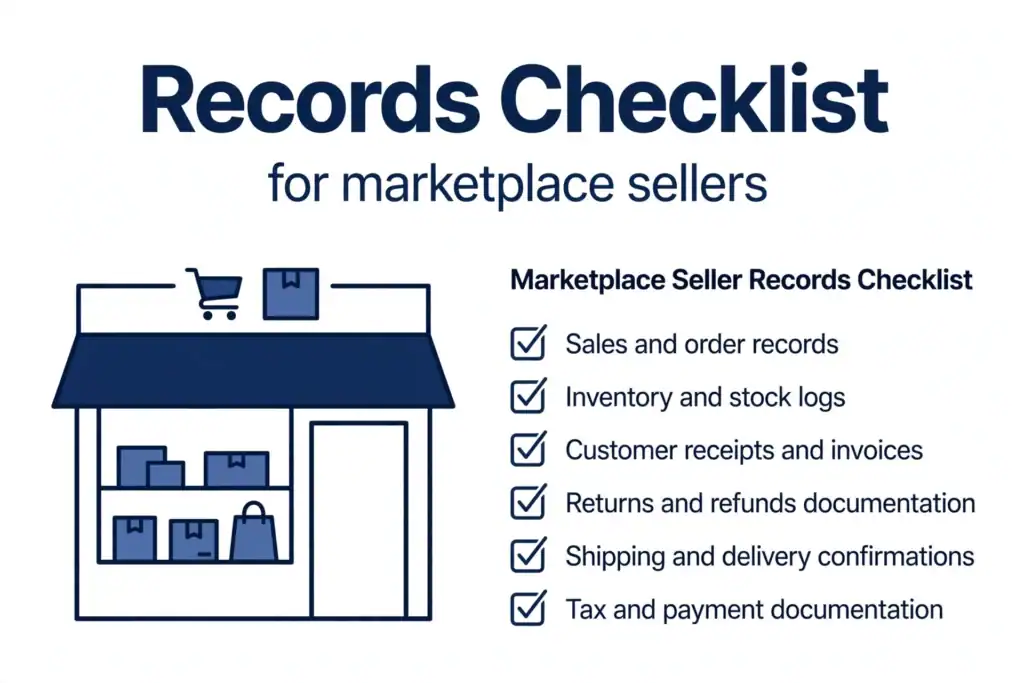
- Keep marketplace tax reports, by state and by period, showing tax collected by the facilitator.
- Keep direct sales records apart from marketplace sales, by state and by period.
- On each return, report direct sales in full, and report marketplace sales only as the state return asks for them, which is often as a separate line or as an excluded amount, based on the state form.
- Keep proof of which sales were marketplace sales, such as order IDs and marketplace reports, for the full record period your state requires.
- If a marketplace report shows no tax collected on a sale that should have been taxed, note it and check with the marketplace and with the state rule, rather than ignoring it.
- Review the split each period, before you file, so a marketplace sale is not counted twice and a direct sale is not missed.
Common mistakes
One mistake is to report all sales, including marketplace sales, as direct sales on your own return. That can lead to paying tax twice on the same sale.
A second mistake is to report no sales at all, because a marketplace collects tax. That can miss direct sales, which are still your duty.
A third mistake is to treat every Shopify sale as a facilitator sale. A sale from your own Shopify shop is usually a direct sale. Check the channel for each sale.
A fourth mistake is to mix marketplace and direct sales in one sales total, with no split. An auditor will ask for the split, and a mixed total makes that work hard.
Marketplace Facilitator Laws by State
Quick reference. Check the linked state source before relying on a row; thresholds and start dates differ by state.
| State | Facilitator must collect? | Official source |
|---|---|---|
| Washington | Yes — must collect and report tax on all retail sales sourced to Washington | WA Department of Revenue — Marketplace Facilitators |
| Colorado | Yes — must collect and remit state and state-administered local sales taxes | Colorado Department of Revenue — Marketplace Facilitators |
| Massachusetts | Yes — if Massachusetts sales exceed $100,000 in a calendar year | Massachusetts DOR — Remote Seller and Marketplace Facilitator FAQs |
| California | Yes — the facilitator is the retailer responsible for collecting, from Oct. 1, 2019 | CDTFA — Tax Guide for Marketplace Facilitator Act |
| New York | Yes — marketplace providers are responsible for collecting, from June 1, 2019 | NY Tax Department — Sales Tax Requirements for Marketplace Providers |
| Texas | Yes — must collect, report and remit tax on all sales through a marketplace | Texas Comptroller — Marketplace Providers and Sellers |
| Florida | Yes — providers must register and collect and remit tax, from July 1, 2021 | Florida DOR — TIP 21A01-03 (PDF) |
Frequently asked questions
Does a marketplace facilitator collect tax in every state?
In most states with a facilitator law, yes, for qualifying marketplace sales. The states, start dates, and sale types covered differ by state. Check the facilitator’s tax page and the state department.
If Etsy collects tax, do I still need to file a return?
You may still need to file, for direct sales, for other states, or because the state asks for a return even when marketplace tax was collected. Filing and collecting are not the same.
Is a sale from my own Shopify shop a facilitator sale?
Usually no. A sale from your own shop is usually a direct sale, and you must collect tax when the normal rules apply. A sale through a marketplace part of Shopify can be different.
What if Walmart collects tax on my marketplace sale?
Then that sale’s tax is handled by Walmart for that sale, in states with a facilitator law. Keep the Walmart report as proof, and do not collect that tax again on the same sale.
Should I count marketplace sales in my nexus total?
That depends on the state. Some states count marketplace sales toward a nexus threshold, and some do not, or count them in a different way. Check the state revenue department for each state where you sell.
This post gives general information only. It is not tax advice. Tax rules change, and they differ by state. Check the facilitator law for the state in question before you split marketplace and direct sales.