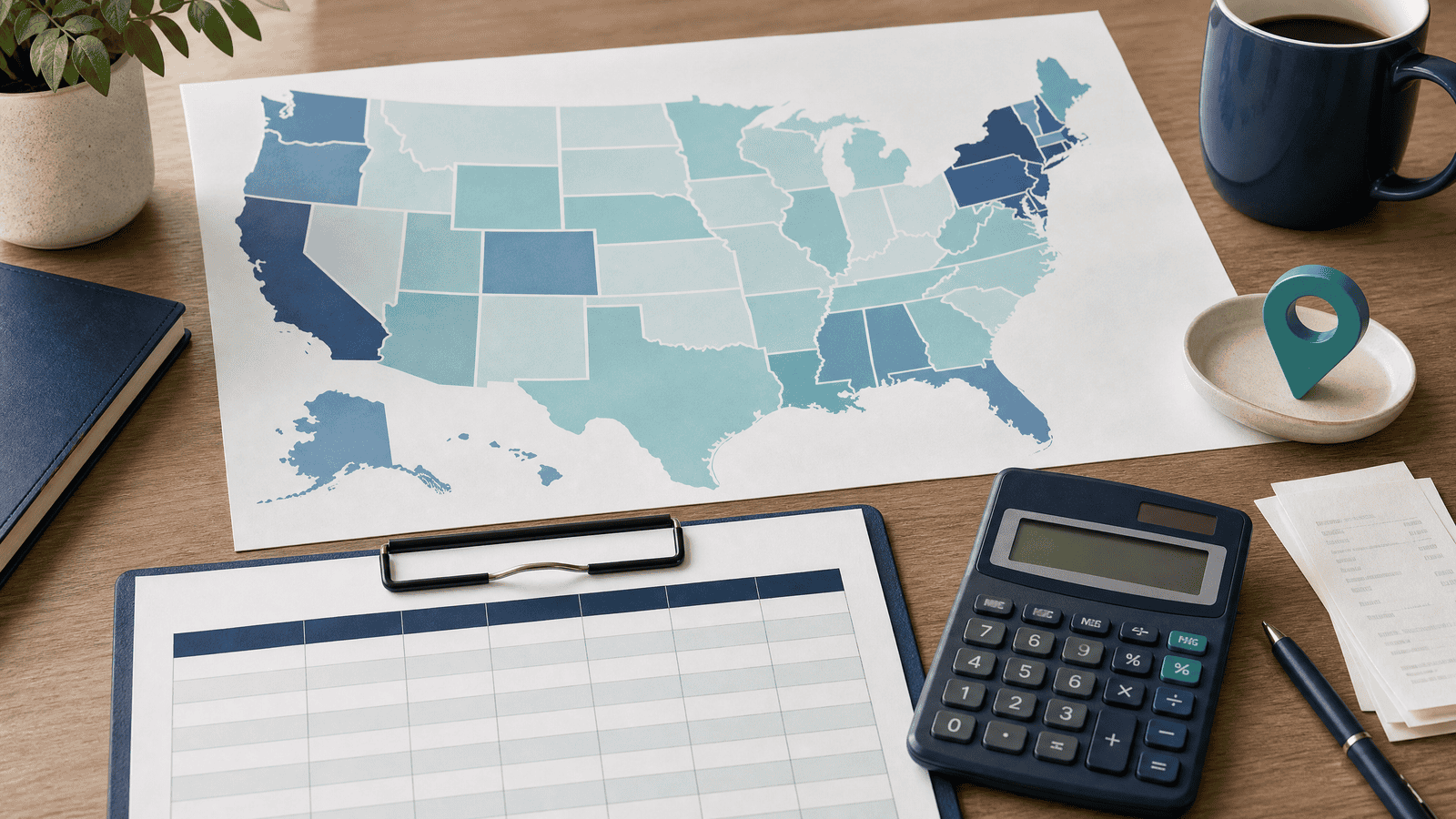
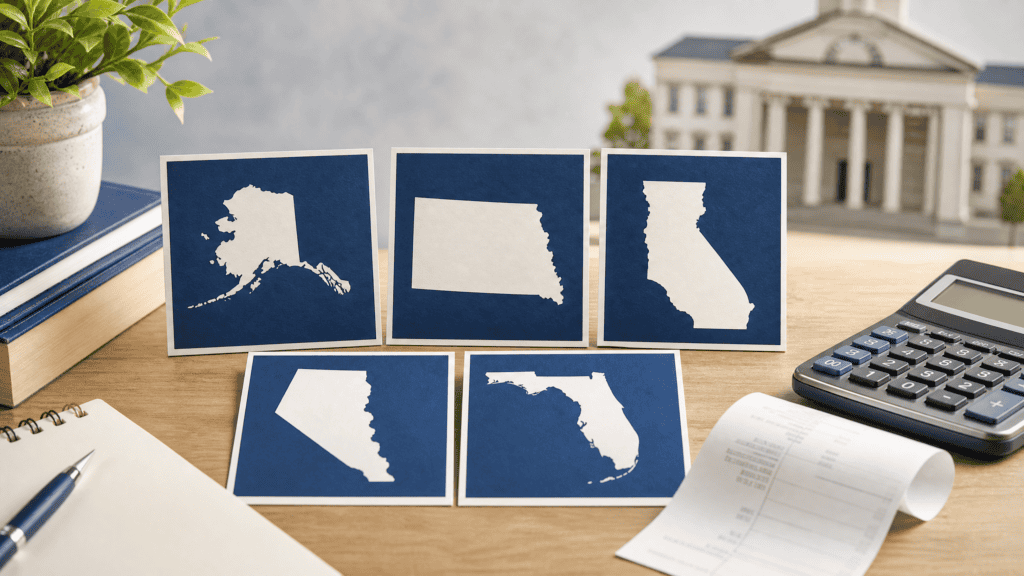
Five U.S. states do not have a general statewide sales tax in the 2026 state-rate data used for this article: Alaska, Delaware, Montana, New Hampshire and Oregon.[1] These are often called states with no sales tax, but that short description needs an important qualification.
“No statewide sales tax” does not mean that every purchase, service, rental or local transaction is tax-free. Alaska is the clearest example because municipalities can impose local sales taxes. Special taxes, use tax, lodging taxes, excise taxes, business taxes and tax on particular goods can also follow separate rules.
If you are comparing states before a purchase or move, check the tax at the actual address and for the actual item. A general state list is a starting point, not a receipt calculation or a filing answer.
Table of Contents
ToggleThe Five States Without a Statewide Sales Tax
Alaska
Alaska does not levy a state sales tax, according to the State of Alaska Office of the State Assessor. Several local municipalities do levy sales taxes, and the state directs businesses to contact the relevant local government for its rules and forms.[2]
Alaska’s local structure can include city and borough taxes. The state says that it is possible for both a city and a borough to levy a sales tax, depending on the jurisdiction. It also explains that local governments can decide what is taxable within the boundaries of their ordinances, subject to state-law requirements.[2]
Delaware
Delaware has no general statewide sales tax in the 2026 state-rate table. That does not mean Delaware has no taxes of any kind. Businesses and shoppers should separate the question of retail sales tax from other taxes, fees, rental taxes, business taxes and special transactions.
Montana
Montana has no general statewide sales tax in the 2026 table. Certain resort areas and special local situations may still require a separate check. Do not treat a no-statewide-tax label as proof that every item or service is free from tax.
New Hampshire
New Hampshire has no general statewide sales tax in the 2026 table. Other state taxes, fees and transaction-specific charges can still exist. A buyer should check the product, location and type of charge rather than assume every total will match the item’s sticker price.
Oregon
Oregon has no general statewide sales tax in the 2026 table. That is different from saying the state has no taxes or that every purchase made elsewhere and used in Oregon has the same treatment. Keep the purchase record and check the rule that applies to the transaction.
Alaska Can Still Have Local Sales Tax
Alaska is different from the other four states in the list because local municipalities can impose sales taxes. The State of Alaska explains that cities and boroughs have authority to enact local sales-tax ordinances and determine what is taxable under local rules.[2]
The rate can therefore depend on the community where the purchase happens or where the item is used. A person buying an item in one Alaskan municipality may not face the same local rate as a person buying the same item in another municipality.
Alaska also has local use-tax rules. The state explains that a use tax can apply when goods are bought outside a taxing authority’s jurisdiction and then brought into that jurisdiction. It says the use tax must equal the local sales-tax rate and is levied on buyers under the applicable local law.[2]
If you are a business, do not look for one Alaska state filing form and assume it covers every local obligation. The state says the proper form may come from the local municipality where the business conducted the transaction and owes the tax.[2]
What No Statewide Sales Tax Actually Means
It describes a state-level retail tax, not every charge
A state list normally answers whether a state levies a broad general sales tax at the state level. It does not classify every item, service, rental, admission, vehicle transaction or local fee. A purchase may involve another tax even when the state has no general retail sales tax.
Local taxes can change the result
Alaska is the main example in this five-state group. Local governments can levy a sales tax even though the state does not. Similar local-versus-state distinctions matter in other states when a page says “no statewide tax” but local jurisdictions still impose a tax.
Use tax can still matter
Use tax is generally linked to taxable goods or services bought without sales tax and then stored, used or consumed in a taxing jurisdiction. If you buy an item in a no-sales-tax state and take it to another state, the destination state’s use-tax rules may matter. The buyer should not assume the original state’s lack of sales tax ends the analysis.
Special taxes are separate questions
Lodging, rental, fuel, tobacco, vehicle, telecommunications and other charges can have their own rules. These should not be folded into a general “sales tax free” claim without a source for the exact transaction.
Taxability still matters
An exempt food item, a taxable service and a business equipment purchase may receive different treatment. The absence of a general state sales tax does not remove the need to ask what was bought, where it was used and who bought it.
How to Check Tax Before a Purchase
Start by identifying the state and local address involved. For an online order, keep the delivery address and the tax line from checkout. For a business purchase, keep the invoice, seller information, item description, exemption document and intended use.
Then ask these questions:
- Does the state have a general statewide sales tax?
- Does the local city, borough, county or municipality impose a tax?
- Is the item, service or rental taxable?
- Was sales tax already collected by the seller or marketplace?
- Could use tax apply where the item is stored, used or consumed?
- Are there special rules for a vehicle, lodging, digital product or business purchase?
- What is the date of the rate table or official source?
Use an official state or local government source whenever possible. The Tax Foundation’s table is useful for a broad state comparison, but it states that local rates vary and that its local figures are population-weighted averages.[1] An average cannot replace a local lookup.
Compare the full purchase cost
A state comparison should include more than the sales-tax line. Add shipping, delivery charges, local fees, lodging or rental charges, fuel costs and the cost of travelling to another state. A lower tax rate may not reduce the total if the trip, shipping or other charge costs more than the tax difference. For an online order, compare the checkout total and the delivery destination rather than the seller’s headline price.
Keep a simple record of the date, seller, item, delivery or use location, amount paid and tax collected. That record helps separate a purchase made in a no-statewide-tax state from a later use-tax question in another state. It also prevents a broad internet list from being treated as proof about a specific receipt. When the amount is material, review the current state or local source for the actual transaction before deciding how to report it.
If the exact purchase total already includes tax and you know the correct rate, a reverse sales tax calculation can help separate the pre-tax amount. It cannot decide whether a purchase is taxable or whether another state’s use tax applies.
Common Questions About No-Sales-Tax States
Which five states have no statewide sales tax?
Alaska, Delaware, Montana, New Hampshire and Oregon have no general statewide sales tax in the 2026 state-rate data.[1]
Is Alaska completely tax-free?
No. Alaska has no state sales tax, but several local municipalities impose sales taxes. Local rules, forms and taxable items should be checked with the relevant municipality.[2]
Are Delaware, Montana, New Hampshire and Oregon free of every tax?
No. The phrase refers to a general statewide sales tax. Other state, local, special, business, rental or transaction taxes may still apply.
Can I avoid use tax by buying in a no-sales-tax state?
Not necessarily. If an item is bought without sales tax and then used in another state, the destination state’s use-tax rule may apply. Check the state where the item is stored or used.
Does a no-sales-tax state always have lower total costs?
No. The final cost depends on price, shipping, local taxes, fees, income or property taxes, travel and the item itself. Sales tax is only one part of the total cost.
How do I check Alaska’s local sales tax?
Contact the local municipality or use the State of Alaska’s tax-jurisdiction resources. Alaska’s official guidance says local governments provide their own rules and forms.[2]
Can an online purchase still create a tax question?
Yes. The delivery address, seller, marketplace, item and tax collected can matter. Keep the checkout record and check the state or local source for the destination.
The five-state list is useful for comparison, but the safe way to review a purchase is to check the actual item, address and current local rule. Start with the state list, then verify the transaction before relying on the final price.
Internal links for publishing
| Suggested anchor | Destination |
|---|---|
| state sales tax rates | https://reversesalestax.com/sales-tax-rates/ |
| what is use tax | https://reversesalestax.com/what-is-use-tax/ |
| reverse sales tax calculator | https://reversesalestax.com/ |
| Texas sales tax | https://reversesalestax.com/states/texas-sales-tax/ |
Writer and publisher QA
| Check | Status |
|---|---|
| One H1 only | Pass in article structure |
| H2 count below 10 | Pass: 5 article H2 headings |
| H3 to H6 hierarchy | H3 used for states and FAQs |
| Focus keyword ownership | Pass: one evergreen states-without-tax URL |
| State list freshness | Verify the current state-rate source immediately before publishing |
| Alaska local caveat | Included and sourced from the State of Alaska |
| Feature image | Generate and inspect before upload |
| Forbidden words and symbols | Run against the saved anti-AI rules file |
| Similarity review | Run against competitor and source pages |
| Responsive review | Test after WordPress publication |
Sources
Source links used for this article are listed below. Rules and rates can change, so check the relevant official guidance for current details.