
A sales tax exemption certificate is a form that lets a qualified buyer buy certain goods without paying sales tax at the time of sale. The seller keeps the form on file as proof that the sale was exempt. Without a valid form, the seller will usually charge tax, and the buyer will have to seek a refund later, which is slower and less certain. If exempt sales are checked later, read Sales Tax Audit Triggers for Small Business for what auditors ask for.
There are two main kinds of certificate that small businesses meet most often. A resale certificate is for goods bought to resell. An exemption certificate for a non-profit, a government body, or another qualified buyer is for goods bought for a qualified use. The steps are close, but the proof you need is different. This post covers both, with the resale case in most detail, because it is the case small retailers meet first.
Sales tax exemption certificate: what it does
In most states, a retail sale is taxable unless a law says it is exempt. A certificate does not create the exemption by itself. It is evidence that the buyer and the sale fit an exemption that the law already allows.
For a resale sale, the idea is simple. Tax is meant to be paid once, by the final buyer who uses the goods. If a retailer pays tax when buying stock, and then charges tax again when selling the same stock to a customer, tax would be paid twice on the same goods. A resale certificate stops the first charge, so tax is paid once, at the final sale.
For a non-profit or government buyer, the idea is different. The law exempts some buyers for some purchases, because of who they are or what the goods will be used for. The certificate shows the seller that this buyer and this purchase fit that exemption. For goods bought without tax and then used in the business, read What Is Use Tax.
A certificate is not a pass to buy anything tax-free. It covers only the goods and the use stated on the form. Goods bought for your own business use, such as office supplies, tools, or equipment you will use and not resell, are not covered by a resale certificate.
Resale certificate: the steps
Step one is to register for a sales tax permit in your state. In most states, you cannot issue a valid resale certificate without an active permit, because the permit number goes on the form. Register through your state revenue department. Keep the permit number and the permit itself where you can find them fast. Filing follows registration, so read How to File Sales Tax for Small Business for the return steps.
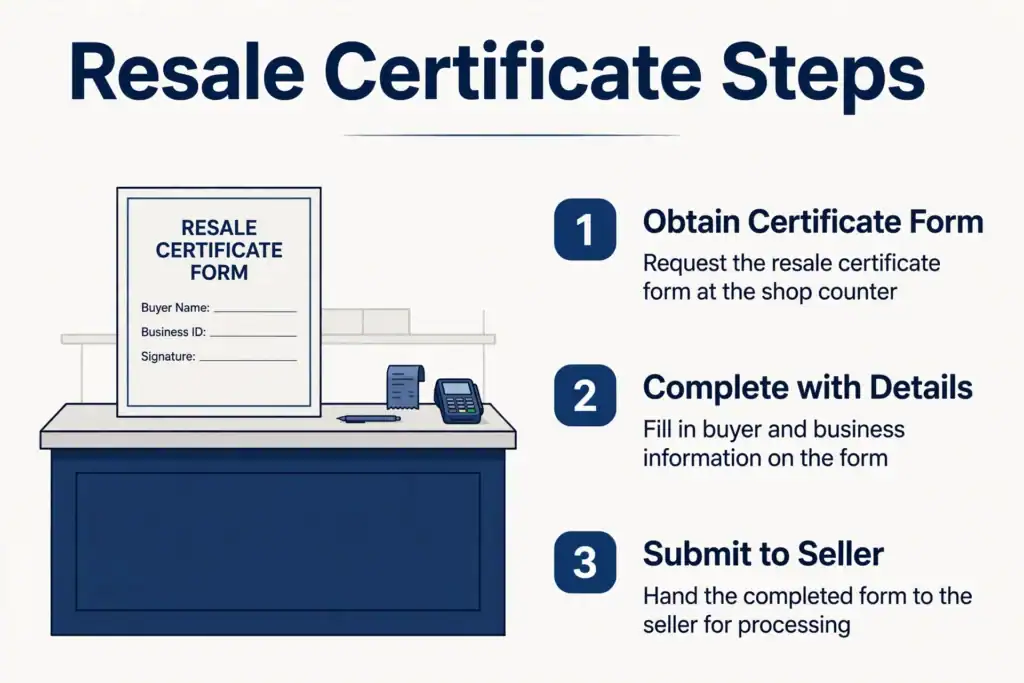
Step two is to get the right form. Many states have their own form. Some states accept a multi-state form for sales into more than one state. Some sellers will accept a written statement that has all the required facts, even if it is not on the state form. Do not assume that. Ask the seller what form they accept before the first order.
Step three is to fill in the form fully. A typical resale certificate asks for the buyer’s legal business name and address, the seller’s name, and the sales tax permit number. It also asks for a description of the goods bought for resale, and a statement that the goods are bought for resale in the normal course of business. Sign it. An unsigned form, or a form with a missing permit number, is a common reason a seller will refuse it.
Step four is to give the form to the seller before or at the time of the first qualifying purchase. The seller keeps it on file and stops charging tax on covered purchases from you. If you give the form after the sale, many sellers will not refund the tax at the till. You may have to claim a refund from the state, and that takes time.
Step five is to use the certificate only for goods you will resell. If you buy goods for resale and then use them in your own business, or take them for private use, that use can become taxable. Keep resale purchases apart from business-use purchases in your records, so you can show the difference later.
A worked example with checked math
Suppose a small shop buys stock for 500 dollars to resell. Suppose the sales tax rate that would apply to a retail sale in that place is 8 percent. This rate is an example only. It is not a rate for any named state.
Without a resale certificate, the tax on that purchase would be 500 dollars times 0.08, which is 40 dollars. The shop would pay 540 dollars in total.
With a valid resale certificate, the tax on that purchase is 0 dollars, because the goods are bought for resale. The shop pays 500 dollars. Later, when the shop sells the stock to a final buyer for 800 dollars, the tax on that final sale, at the same example rate of 8 percent, is 800 dollars times 0.08, which is 64 dollars. The final buyer pays 864 dollars in total. Tax is paid once, at the final sale, not twice.
If the shop later takes 100 dollars worth of that stock for its own use, that 100 dollars is no longer a resale purchase. At the example rate of 8 percent, the tax on that use would be 100 dollars times 0.08, which is 8 dollars. The shop should report and pay that tax, or it will have an unpaid tax amount on its records.
Exemption certificates for non-profits and other qualified buyers
A non-profit buyer usually needs more than a sales tax permit. The buyer may need a letter or a ruling from the state that confirms its exempt status. The seller may ask for that letter as well as the certificate form. The rules for which purchases are exempt can be narrow. In some states, a non-profit is exempt for goods used in its charitable work, but not for goods used in a shop or cafe it runs as a business.
A government buyer, such as a city office or a school, usually has its own proof of status. A seller should still ask for the form and keep it on file, rather than taking a verbal claim.
If you are a seller and a buyer claims an exemption, do not accept the claim on trust alone. Ask for the form, check that it is signed, check that the permit number or exempt status is stated, and check that the goods match the exemption. If the form is missing or does not fit the sale, charge tax. A missing form can turn an exempt sale into a taxable sale in a later review, and the seller can be asked to pay the tax.
Common mistakes
One mistake is to use a resale certificate for goods you will use, not resell. Office chairs, cleaning products, computers for staff use, and tools for your own workshop are not resale goods. Buying them with a resale certificate can lead to tax, interest, and a penalty.
A second mistake is to give a certificate to a seller in a state where you have no permit or no valid claim. A form from one state does not always work in another state. Check the seller’s state rule before you send the form.
A third mistake is to leave a field blank. A missing permit number, a missing description of goods, or a missing signature can make the form invalid. Fill in every field, even if it feels repetitive.
A fourth mistake is to lose the form. A buyer who cannot show the form later may lose the exemption. A seller who cannot show the form later may have to pay the tax. Keep copies on both sides of the sale.
A fifth mistake is to assume a certificate never ends. If your permit lapses, if your business closes, or if you stop reselling the goods, the certificate should not be used. Tell sellers when your status changes.
Checklist for buyers
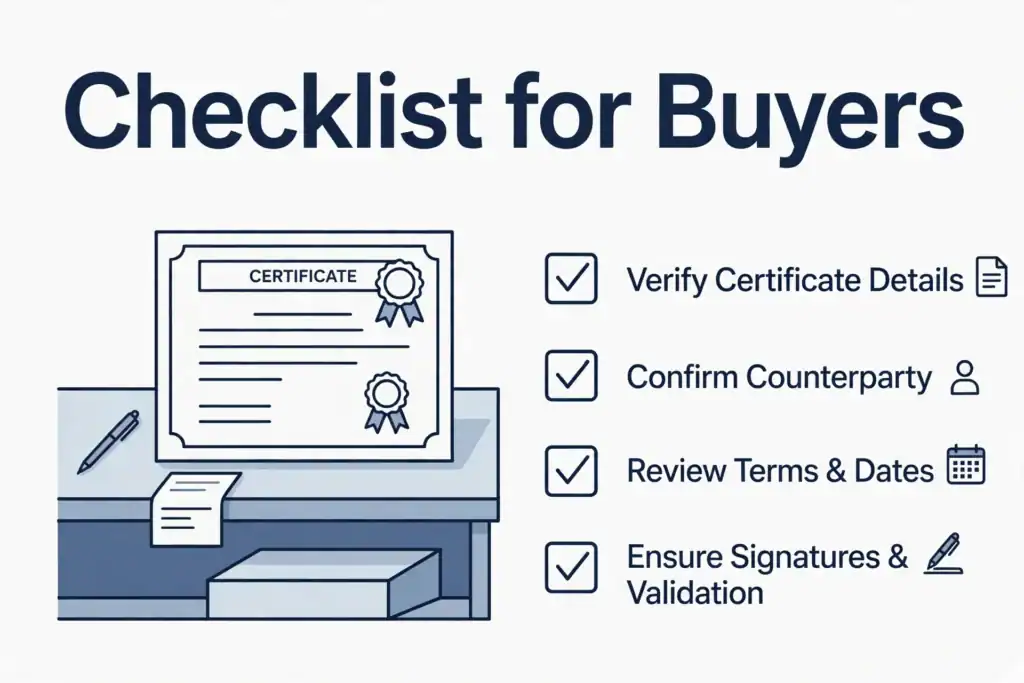
- Register for a sales tax permit and keep the number ready.
- Get the correct form for the seller’s state.
- Fill in business name, address, permit number, goods description, and the resale statement.
- Sign the form.
- Give the form before or at the time of the first qualifying purchase.
- Use it only for goods you will resell.
- Keep a copy, with the date given and the seller name.
- Tell sellers if your name, address, permit, or goods change.
Checklist for sellers
- Ask for the form before you treat a sale as exempt.
- Check the signature, the permit number or exempt status, and the goods description.
- Check that the goods match the exemption claimed.
- Keep the form by buyer name and date.
- Charge tax if the form is missing, unsigned, or does not fit the sale.
- Review blanket certificates on a set cycle and ask for new forms when facts change.
Resale/Exemption Certificate Forms by State
Quick reference. Use the form the state source names for that state; form numbers are given only where the official source states them.
| State | Form | Official source |
|---|---|---|
| California | CDTFA-230 — General Resale Certificate | CDTFA — Publication 103, Sales for Resale |
| Texas | Form 01-339 — Texas Resale Certificate | Texas Comptroller — Sales Tax Forms |
| New York | Form ST-120 — Resale Certificate | NY Tax Department — Sales Tax Exemption Documents |
| Florida | Form DR-13 — Annual Resale Certificate for Sales Tax | Florida DOR — Annual Resale Certificate |
| Ohio | Form STEC B — Sales and Use Tax Blanket Exemption Certificate | Ohio Department of Taxation — Exemption Certificates |
| Pennsylvania | Form REV-1220 — Pennsylvania Exemption Certificate | PA Department of Revenue — Sales, Use and Hotel Occupancy Tax |
| New Jersey | Form ST-3 — Resale Certificate | NJ Division of Taxation — Sales and Use Tax Forms |
| Tennessee | Tennessee Sales and Use Tax Certificate of Resale (SST Certificate of Exemption also accepted) | TN Department of Revenue — Resale Certificate |
| Minnesota | Form ST3 — Certificate of Exemption | MN Department of Revenue — Sales Tax Exemptions |
| Missouri | Form 149 — Sales and Use Tax Exemption Certificate | Missouri DOR — Form 149 (PDF) |
Frequently asked questions
Do I need a sales tax permit to get a resale certificate?
In most states, yes. The permit number goes on the form, and a form without a valid permit number will often be refused. Register first, then issue the form.
Can I use one resale certificate in every state?
Not always. Some states accept a multi-state form. Others require their own form. Check the seller’s state rule before you send a form from another state.
What if I forget to give the certificate before the sale?
The seller will usually charge tax. You may be able to claim a refund from the state, but that is slower than giving the form on time. For the next sale, give the form first.
Does a resale certificate cover services?
A resale certificate covers tangible goods bought for resale. Services are treated differently, and many services are not covered by a resale certificate. Check the state rule for the service in question.
How long does a blanket certificate last?
It depends on the state and on the seller’s policy. Some sellers ask for a new form each year. Some states set a time limit. Keep a renewal date for each seller and check it on time.
What happens if I use a resale certificate for my own use?
That use can become taxable. At an example rate of 8 percent, 100 dollars of goods taken for own use would carry 8 dollars of tax. You should report and pay that tax, rather than leaving it unpaid.
This post gives general information only. It is not tax advice. Tax rules change, and they differ by state. Check the form and permit rule for the seller’s state before you accept or give a certificate.